Showing posts with label Application and OS News. Show all posts

Atom technologies join hands with travel firm eZeeCLOUD for web, mobile payments

Wednesday, 29 August 2012


eZeeCLOUD Infoserves Pvt Ltd has entered into a partnership with atom technologies (atom), an enterprise promoted by Financial Technologies India Ltd. a subsidiary of Financial Technologies (India) Limited (NSE: FINANTECH, BSE: FINTECH), for deploying atom’s web, IVR and mobile payment platforms. Customers of eZeeCLOUD can now choose from atom’s multiple new-age payment options to make payments through atom Paynetz (Net/IPG based payments), atom IVR (Payments on the call) and atom Mobile Apps.


eZeeCLOUD, which is headquartered in Bangalore, has more than 2,500 hotels registered on its portal. The tie-up with atom — India’s top integrated payments solutions provider—is a part of eZeeCLOUD’s customer satisfaction and business augmentation objective. atom’s sophisticated and user-friendly payment services will assist the hotels registered with eZeeCLOUD to accept payments on a real-time basis and enable round-the-clock transactions.

atom technologies is the one of the largest m-Commerce solutions provider in the country. Its clientele span government and private sectors across various industry verticals such as DTH, Utilities, Travel and Tourism, Mutual Funds, Insurance, Education, Entertainment, Retail etc. Apart from providing end users with the flexibility of choosing various payment options and transacting 24/7, eZeeCLOUD’s deployment of atom’s net banking solutions, mobile applications and IVR solutions will also provide its customers the advantage of secure transactions. atom’s payment solutions will ensure that the customer’s credit card, debit card and bank account details stay absolutely secure while they shop for eZeeCLOUD’s travel products.


Mr. Rajesh Kumar Kotta, CEO & Founder, eZeeCLOUD announced that our hospitality ecosystem will provide real-time and synchronised information flow for hotels, travel agents, corporate clients and guests. We intend to integrate all the solutions for the stakeholders and aspire to create an equitable hospitality ecosystem. We are aiming at becoming the largest aggregator of properties, with real-time connectivity to all the solutions in our ecosystem. atom will partner with us in this endeavour and provide our customers with a payment solution that can be accessed securely over different channels.

Mr. Dewang Neralla, Director& CEO, atom technologies, added, atom is the market leader in the IVR (interactive voice response) payment solutions services in India with a market share of over 80%. The travel industry is one of the key industries that we are focusing on right now. Currently, we have a huge network for IPG/net banking payments and have tied up with more than 30 banks for this facility. I am sure this tie up will help users avail of our innovative solutions to make payments for eZeeCLOUD’s products.

HP Targets Apple IT Consumerization With Windows 8 Blitz


Hewlett-Packard (NYSE:HPQ) is poised to mount a massive product and sales offensive around Windows 8 aimed at taking the wind out of rival Apple (NSDQ:AAPL)’s momentum, which is being driven in large part by the consumerization of IT.

This fall, HP will launch a massive product and channel sales offensive around Windows 8 aimed at challenging Apple on a number of fronts, HP Director of Americas Channel Marketing Matt Smith told CRN Tuesday.

“It is going to be disruptive with the balance between Microsoft (NSDQ:MSFT) and Apple,” said Smith in an interview at the XChange 2012 conference at the Gaylord Texas in Dallas, Texas. “It is going to be disruptive in favor of Microsoft’s solutions driving to the cloud with multiple products. You are going to see more and more products, more and more variety, all relying on the Windows 8 cloud environment. And, HP is going to do it better than everybody else. We believe this is the tipping point of a massive refresh cycle.”

Microsoft has promised that Windows 8 will be generally available at the end of October. Microsoft CEO Steve Ballmer, for his part, declared that Windows 8 marks a turning point of sorts in the innovation battle against Apple.

"We are trying to make absolutely clear we are not going to leave any space uncovered to Apple," Ballmer told CRN last month in an exclusive interview.

Smith declined to provide details on HP's Windows 8 tablets and ultrabooks but stressed that HP has already begun its consumerization of IT march by adding enterprise capabilities to some of its consumer notebook line.

Specifically, Smith pointed to HP’s Envy Pro consumer laptop, which is available with Windows 7 Professional and includes a Trusted Platform Module (TPM) security chip, additional manufacturing quality and reliability and a three-year warranty, up from only a single-year warranty.

"We’ve put all the IT specifications in the cool, whiz-bang consumer products you like," Smith told CRN. "Consumerization of IT is going to be big. People are going to bring more products [to work] that are personalized to them."

New Red Hat Channel Exec Focuses On Partner Adoption Of Expanded Product Line


Red Hat is best known as a leading supplier of Linux operating system software. But, as the Red Hat's product line has grown to include middleware, cloud technology, virtualization software and storage management software, so has the need to introduce those products to the company's thousands of channel partners.

And, that's what Jerry Lumpkin, Red Hat's new senior director of channel sales and alliances, is currently focused on.

"This is much more than a point-product play," said Lumpkin in a phone interview. "There's a tremendous growth story in the expansion of the product line. It's a much different message from the Red Hat perspective of a few years ago. That's really the challenge and the opportunity."

Lumpkin, who joined Red Hat in mid-June, is something of an industry institution, having served in a number of channel and sales posts over the last 25 years. His resume includes a four-year stint as vice president of channel sales at Toshiba America Information Services (2005-2009), a year-and-a-half as senior vice president of worldwide marketing at FrontRange Solutions (2002-2003) and three years as senior vice president of marketing at Ingram Micro (NYSE:IM) (1999-2002).

In his new post, Lumpkin reports to Roger Egan, Red Hat vice president of channel sales in North America.

Today, about 60 percent of Red Hat's sales are through the channel. A significant chunk of that revenue comes from the vendor's flagship Red Hat Enterprise Linux (RHEL) software.

But, some of Red Hat's fastest growing products include the company's JBoss middleware software, which Red Hat gained when it acquired JBoss in 2006, Red Hat Enterprise Virtualization, which is based on the open-source KVM hypervisor, and Red Hat Storage Server, gained from the company's $136 million acquisition of Gluster in October 2011.

Lumpkin said those products provide RHEL resellers with an opportunity to sell a complete stack of open-source software. The challenge for the company -- and for Lumpkin -- is getting that message out to Red Hat's channel partner ranks and putting in place the right programs to make it happen. Ensuring that the storage management software is properly integrated and packaged for channel distribution is also on the to-do list.

To that end, Lumpkin is devoting a lot of time meeting with partners "and doing a lot of listening," he said, to understand what partners like about Red Hat's channel programs and where they need improvement. "We're at a point where things are coming together," he said, hinting at announcements to come but declining to provide details.

IBM Boosts Social Business App Lineup With $1.3 Billion Acquisition


IBM (NYSE:IBM) is acquiring Kenexa Corp., a developer of cloud-based social networking applications used by businesses for recruiting and talent management, for approximately $1.3 billion.

IBM sees opportunities to integrate Kenexa's applications with other IBM products, including its business analytics, social media, human resource management and business process management software and services, the company said Monday.

"It's all about changing the way people work," said Alistair Rennie, IBM general manager of social business, in a phone conference. "We see this as a big, strategic growth area."

Rennie also said the combination of Kenexa's software and other IBM products "will create some unique and very high-value opportunities for the IBM partner community."

IBM said it expects to complete the acquisition later in the fourth quarter and will integrate Kenexa's operations with IBM's software and services groups. Kenexa CEO Rudy Karsan and the rest of the Kenexa management team will join IBM, executives said on the phone conference, but it wasn't clear whether all 2,800 Kenexa employees would be retained.

The $46-per-share cash offer for Kenexa is subject to Kenexa shareholder and regulatory approval.

Wayne, Pa., Kenexa reported fiscal 2011, ended Dec. 31, sales of $282.9 million, up 44 percent from $196.4 million in fiscal 2010. The company has more than 8,900 customers, including Boeing, Ford, General Electric and Starbucks.


With the Kenexa acquisition, IBM joins a growing number of vendors adding social media for businesses to their product lines. Salesforce has offered its Chatter service since 2010 and earlier this month announced plans to augment that with a new Salesforce Communities service. The company also recently acquired Buddy Media, a supplier of social media marketing applications.

Last month, Microsoft (NSDQ:MSFT) completed its $1.2 billion acquisition of Yammer, a developer of cloud-based social networking services for businesses. And, Oracle (NSDQ:ORCL) has announced the acquisition of several social media software companies in recent months, including social marketing application developer Vitrue and "social intelligence" software vendor Collective Intellect.

On the recruiting and talent management side, IBM's Kenexa acquisition parallels SAP's $3.4 billion acquisition of SuccessFactors, a developer of cloud-based human capital management applications, earlier this year.

The Daily App: Found For Mac OS X


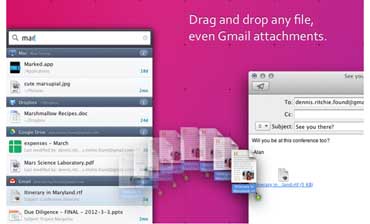
Ever have trouble finding a file you just downloaded? Now imagine sifting through thousands of files uploaded, created or saved to the cloud over the course of a year or two. Well sift no more with today’s Daily App. Found for Mac OS X searches for local files as well as those on cloud services such as Dropbox, Gmail and Google Drive and brings them together into single, easy-to-use window.

The Daily App, Found


For machines running Mac OS X 10.6.8 or higher, the free app from productivity app developer Found Software applies an interface similar to Apple's Spotlight, narrowing the list of files as more letters are entered into the search. Files are represented as thumbnails along with their path and creation date, and a tab appears that shows how many files matched the search term. Clicking on a listed file displays a preview.

Files can be opened directly, moved to the desktop or emailed as an attachment. Found installs as a menu-bar icon and can be quickly launched by double-tapping the control key. After it indexes your data, searches are fast, but preview time seems to vary by file size and type.

CRM Apps - Bridging Relationships for Enterprise

Saturday, 18 August 2012


When it comes to building and nourishing relationships, CRM applications are playing a pivotal role for the enterprise community

With enterprise giving a lot of importance to relationship building for their end customers, relationship based marketing is emerging as the core marketing activity for businesses operating in fiercely competitive environments. On average, businesses spend six times more to acquire customers than they do to keep them.

Hence a number of enterprise are now paying more attention to their relationships with existing customers to retain them and increase their share of customer’s purchases.

Globally entrenched service organizations have been pioneers in developing customer retention strategies. Banks have relationship managers for select customers, airlines have frequent flyer programs to reward loyal customers, credit cards offer redeemable bonus points for increased card usage, telecom service operators provide customised services to their heavy users, and hotels have personalized services for their regular guests.

When customers enter into a relationship with a firm, they are willingly foregoing other options and limiting their choice. Some of the personal motivations to do so result from greater efficiency in decision-making, reduction in information processing, achieving more cognitive consistency in decisions and reduction of perceived risks with future decisions.

Further developments in information technology, data warehousing and data-mining have made it possible for companies to maintain a closely associated relationship with their end customers.

Enterprise community can now manage every single contact with the customer from account management personnel, call centers, interactive voice response systems, on-line dial-up applications, and websites to build lasting relationships.
 CRM Apps – Bridging Relationships for Enterprise


Even though customised as well as off the shelf CRM app driven technological solutions are available in the marketplace, businesses need to do a lot more than just adopt these solutions to implement customer relationship management (CRM) application driven practices.

And hence, successful implementation of CRM requires a strategic approach, which encompasses developing customer centric processes, selecting and implementing technology solutions, employee empowerment, customer information and knowledge generation capabilities to differentiate them, and the ability to learn from best practices. Moving forward this trend is likely to help the enterprise community close tag on to their end customers in a better manner.a

How To Be Agile In IT

Tuesday, 24 July 2012


he term "agile IT" has been around, but lately, it's gaining traction. With growing emphasis on time to market, and mounting global competition, solution providers are tasked with responding and adapting quickly to the needs of customers. Julie Parrish, vice president of worldwide sales at NetApp, shares how an agile IT infrastructure can enable business right now.—Jennifer D. Bosavage, editor

You've probably been hearing the words agile and agility a lot recently, and there's a good reason for it. We're entering a new era in technology, an era in which IT agility is going to be central to business success. Because your customers are increasingly hearing this message, you as a channel partner need to be ready to help them think differently about how their IT can respond at the pace of global business today.

Related: How to Update a Customer's Data Protection Plan

Competition, an always-on global economy, and the urgency to make data a propellant for advantage all require your customers to have an infrastructure that’s agile enough to cope with their very dynamic business environment.

Customers want to accelerate their business with greater efficiency and productivity, but they must think differently to remove the complexity, cost, and inefficiencies of decade-old IT approaches. They are reaching an inflection point, and they must fundamentally rethink their approach to information technology to be more agile. This is change. This is our future. This is your opportunity.

SAP Quarterly Software Sales Surpass 1 Billion Euros


SAP's software sales exceeded 1 billion Euros in its second quarter, the company said Tuesday, the first time the company's quarterly software sales have surpassed that threshold.

SAP, Walldorf, Germany, also reported that revenue from cloud subscriptions and support reached 52 million Euros ($62.9 million) in the quarter, including revenue from its SuccessFactors acquisition.

For the second quarter ended June 30, SAP reported total revenue of 3.9 billion Euros ($4.7 billion), up 18 percent from 3.3 billion Euros ($4.0 billion) in the second quarter of fiscal 2011. Profit after tax was 661 million Euros ($799 million), up 12 percent from 588 million Euros ($711 million) in the earlier quarter.

"We reached the upper end of our second-quarter software revenue guidance range and were at the midpoint of the software and software-related service revenue guidance range," said Werner Brandt, SAP CFO, in a statement. He said the company was on track to meet its 2012 targets and its longer-range 2015 goals.

Software sales in the second quarter were up 26 percent to 1.1 billion Euros ($1.3 billion) from one year earlier. Support revenue grew 16 percent to just more than 2 billion Euros ($2.4 billion).

Growing its cloud software offerings is one of SAP's major goals. Revenue from cloud subscriptions and services one year earlier was only 4 million Euros ($4.8 million). While some of the most recent quarter's 52 million Euros in cloud-related revenue was generated by the company's Business ByDesign on-demand applications, much of it was the result of SAP's $3.4 billion acquisition earlier this year of SuccessFactors, the provider of cloud-based human capital management applications.

Sales for the first six months of fiscal 2012 reached 7.2 billion Euros ($8.8 billion), up 15 percent from 6.3 billion Euros ($7.6 billion) in the first half of fiscal 2011.

Software sales for the first half of fiscal 2012 were 1.7 billion Euros ($2.0 billion), up 17 percent from 1.5 billion Euros ($1.8 billion) one year earlier. Revenue from cloud subscriptions and support in the first six months was 81 million ($97.7 million) Euros compared to 8 million Euros ($9.7 million) in the same period one year ago.

Support-related revenue in the first half of fiscal 2012 was 4.0 billion Euros ($4.8 billion), up 15 percent from 3.4 billion Euros ($4.2 billion) in the same period one year ago.